
NextGen UBE Assessment Consulting
Esquired helps bar preparation providers and law schools turn NextGen UBE assessment data and scoring systems into skill-level formative feedback.
Have your platform tell a candidate not just what they got wrong, but which underlying skill needs improvement and how to improve it across subjects and fact patterns — through a diagnostic framework built from years of grading real bar exam answers. Licensing is the scalable way to put that framework inside your product.
The Problem: "63% in Contracts" Is Not a Diagnosis
Subject-level reporting is the industry standard, and it cannot support remediation.
Told they scored 63% in Contracts, a candidate has no clear next step. Study Contracts harder? The student who has memorized every rule and cannot apply it under time pressure, and the student who reasons well from rules they have half-learned, receive the identical report and the identical advice. One of them spends the next six weeks on the wrong work.
Skill-level reporting answers the question the candidate is actually asking. Your rule knowledge is solid. Where you are losing points is in connecting those rules to specific facts — consistently, across every subject. That changes what the next practice session should contain.
The same diagnosis can aggregate across question types. An application weakness visible in multiple-choice performance and one visible in performance task scoring are the same finding reinforcing itself, rather than two disconnected numbers in two dashboards.
NCBE’s seven Foundational Skills are the right basis for deciding what to test. However, they were not designed as a diagnostic instrument. A candidate who scores poorly on a counseling set has demonstrated weakness in “client counseling and advising” — but whether they lacked the rule, misapplied it, or communicated it poorly is what determines the fix, and that label cannot tell you.
Why the NextGen UBE Structure Makes This Newly Important
The NextGen UBE tests the same underlying lawyering skills through three different formats, each scored differently.
- Standalone multiple-choice – 49%. One hundred twenty questions in select-one and select-two formats, with partial credit on select-two. Machine scored.
-
Integrated question sets – 21%. Six sets built on common fact scenarios, split between counseling sets (multiple-choice and short answers), and drafting sets (medium answers).
- Performance tasks – 30%. Three closed-universe tasks with a file and library. Standard PTs carry one extended response; legal research PTs combine short answers and multiple-choice with a medium-length writing assignment.
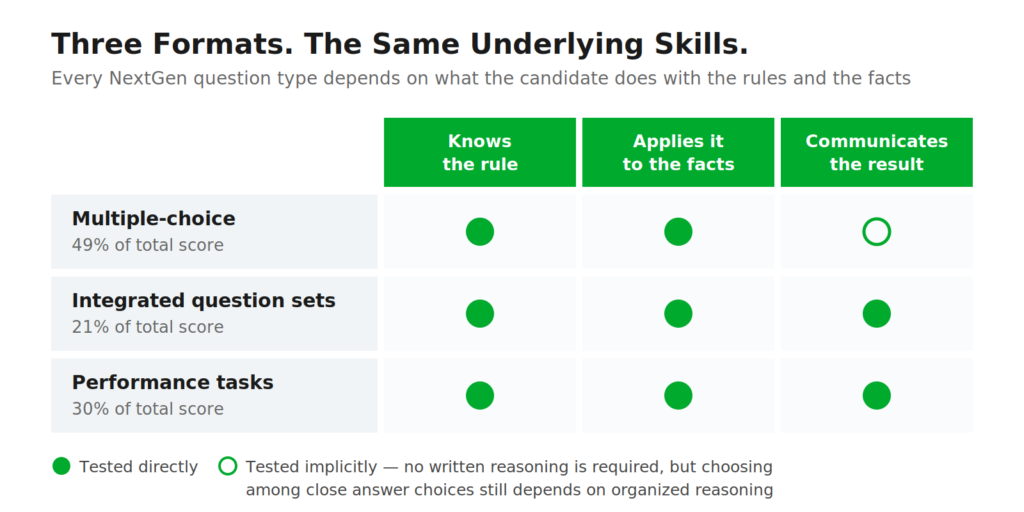
That structure creates a problem most assessment systems were not built for. A candidate’s weakness does not live in one format. It surfaces in the multiple-choice answers they choose, the short answers they write, and the performance tasks they draft — scored three different ways, and usually reported in three separate places.
Diagnosis that works in only one format sees only part of the evidence. Diagnosis that works across all three can tell a candidate something no single score can: that the same underlying weakness is costing them points everywhere, and what to do about it.
A Diagnostic Lens That Works Across Formats
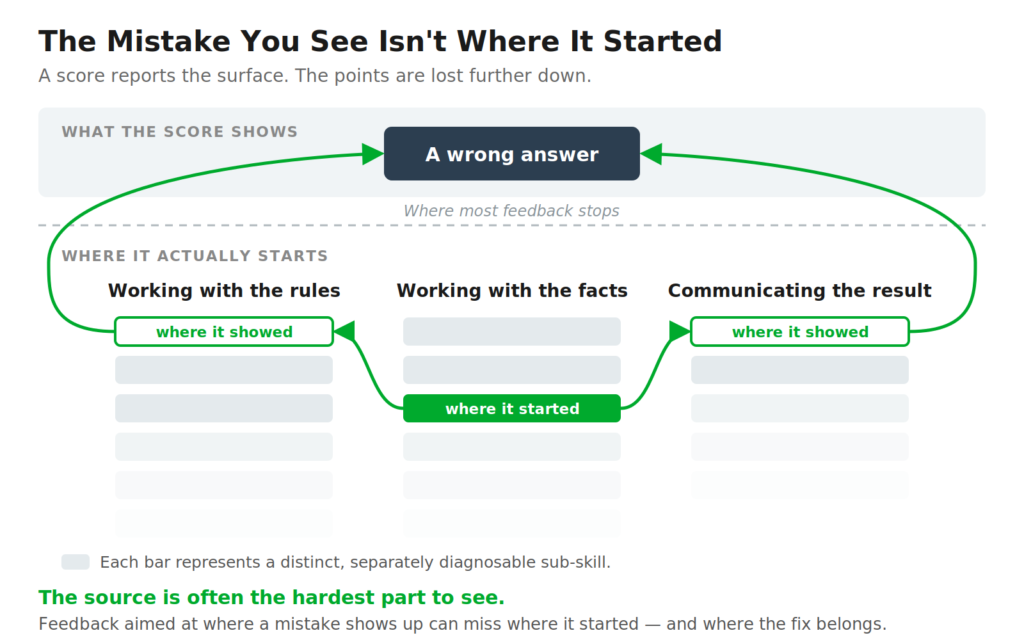
“Didn’t know the rule” is the diagnosis most feedback reaches for. In my experience grading, it often isn’t the real one.
Most candidates who lose points know more law than their answers show. The breakdown often happens in how they work with the facts — the part of an answer that is hardest to see and hardest to diagnose. And it rarely shows up where it started. Feedback aimed at where a mistake appears sends the candidate to fix the wrong thing.
Two examples:
Example 1:
A candidate misses a multiple-choice question.
Typical feedback: the correct answer is B, because… The feedback may be supplemented by a “Tip”: review the rule.
But they knew the rule. What they missed was the fact that made a different rule govern — and the answer they chose is exactly where that misreading leads. Reviewing the law changes nothing. Learning to recognize which facts are doing the legal work does.
Example 2:
A performance task response reads as disorganized.
Typical feedback: work on your organization. The feedback may be supplemented by a “Tip”: stick to IRAC.
But the writing isn’t the problem. The candidate never decided which issues the facts made important, so every point got equal weight and the answer sprawled. A writing lesson won’t fix it. Deciding what matters before the first sentence will.
It’s the same pattern in both. The mistake showed up as a problem with the rules or with the writing. It started in the facts.
The diagnosis works across formats. A written response shows the breakdown on the page. A multiple-choice answer shows it in the choice the candidate made — where the item is built to carry that signal, which not every item is. Knowing which items do is part of the work.
These two examples are a small part of it. Working with the rules, working with the facts, and communicating the result each break down into a range of distinct sub-skills — each with its own signature in a response, its own relationship to the others, and its own remedy. Recognizing that a candidate struggled is easy. Knowing which of the many ways they struggled, what caused it, and what will actually move the score is the work.
Why This Matters Commercially
Give students something actionable.
A score says a student is behind. An answer explanation clears up one question. Skill-level feedback goes further: it names the skill behind the error and shows how to improve it across subjects — so the student knows what to work on, how to improve it, and what better performance looks like in the next question.
Make the product feel smarter, not just bigger.
Most bar prep programs already have lectures, outlines, practice banks, graded essays, and increasingly AI feedback. The differentiator isn’t another content library. It’s whether the system can explain why a candidate is losing points, so they can correct it on the next assignment.
Get more from the data you already have.
Your platform already captures multiple-choice results, written responses, scores, and feedback. Connecting those signals across NextGen UBE formats can reveal recurring skill weaknesses that subject-level reporting leaves invisible.
Make AI feedback defensible.
Generating feedback is easy. Demonstrating that it tracks what a scoring rubric actually rewards is harder. A calibrated diagnostic framework gives AI feedback something measurable to be tested against.
Protect your institutional relationships.
Law school contracts, enrollment, and renewals reference published outcomes. Feedback that misdiagnoses sends candidates to practice the wrong skill — and that damage surfaces late and diffusely.
Move while the field is level.
The first NextGen UBE administration was July 2026. Build it once, apply it across the program, and make it part of the product by the time the legacy UBE and legacy California Bar Exam retire in July 2028.
How I Work
Most engagements start with a focused review of what you’re already doing. From there, I can diagnose the gaps, validate the scoring and feedback, and build the calibration standards needed to make the system work. For organizations that want to run the methodology internally, the long-term model is licensing the framework.
Diagnose
Make the data you already have diagnostically useful.
Map existing assessment data to the capabilities each item or response actually reveals. Identify where subject-level reporting is masking recurring skill weaknesses, and build a common diagnostic structure across multiple-choice, integrated question sets, and performance tasks.
Validate
Test whether your scoring and feedback tell the truth.
Compare AI-generated feedback and human scoring against a calibrated standard. Identify systematic divergences, weak inferences, and places where an apparently sophisticated system is producing little actionable information.
Calibrate
Build the standards the system depends on.
Create analytic rubrics, benchmark responses, annotated score points, and calibration materials so that graders—and automated systems—apply the same standard consistently.
License the Framework
For organizations that want to bring the methodology in-house.
License the diagnostic framework and feedback library, adapted to your formats and integrated into your existing product. Your team operates the system; the framework supplies the diagnostic model, skill structure, and matched guidance.
Consulting can identify and validate the opportunity. Licensing lets your organization own the implementation.

Why Jay Bijlani?
The rubric is new. The judgment isn’t. No one has years of NextGen grading experience yet. What transfers is experience with the harder, underlying problem: turning a scoring standard into consistent evaluation, and turning evaluation into instruction a candidate can act on.
Grading and calibration. I graded thousands of answers on the California Bar Examination — widely regarded as one of the most demanding in the country — under a formal calibration process designed so that the same response earns the same score no matter who reads it. Calibration is also one of the three key features of NCBE’s NextGen written scoring.
Grader training. I oversaw a law school’s practice-essay feedback program and trained the graders who staffed it, keeping their feedback consistent and useful. It’s the same problem providers face now, with human graders and automated ones.
A framework built from practice. That work, along with teaching as a Clinical Professor of Law, became the diagnostic framework described on this page, refined through one-on-one candidate preparation ever since.
See It Work
The best way to evaluate this is to see it applied, not to read a proposal.
1. See the Approach.
A 45-minute walkthrough using prepared NextGen-style responses: how an answer reveals a specific skill gap, where it shows up, and how the diagnosis guides improvement. We’ll leave plenty of time for your questions and for where it might fit your product. No student data needed.
2. Evaluate it on your own work.
If there’s a fit, we scope a paid evaluation on a small, agreed set of anonymized responses. Scope, fee, and data-handling terms are agreed before anything is shared.
3. Decide.
We review the results against the criteria we set together, and decide whether to move to a license.
© 2026 Esquired Inc. All Rights Reserved.